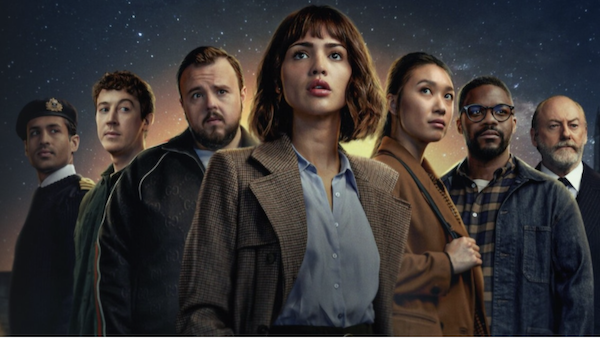
Recently, I watched “three body problem” (3B) in Netflix.It is an interesting movie originated from the same name novel written by Liu Cixin from China. About one year back, I watched TV series cast by Tencent Video based on the same novel. It would be interesting to discuss them together since both are famous TV maker and based on the same story. The reflections may quite depend on the order of watching, i.e., there may be significant differences in feelings if I watched Netflix's version before Tencent's.
Netflix 3B did not exceed my expectations. Perhaps my expectations for Netflix's version were set too high before watching. Lets discuss more details.
In terms of character portrayal, Netflix's version is slightly inferior (possibly related to my understanding of English language and culture). Tencent Video's portrayal of the detective (Da Shi), Ye Wenjie, and Wang Miao is very detailed, with good portrayal of inner thoughts; comparatively, Netflix's portrayal of characters is not as deep, although it's still decent. For example, the detective in Netflix's version has an Asian face but lacks the "essence" of an Asian person (although both detectives love to drink), lacking the humor, roughness, and grassroots spirit of Da Shi. Both being nano-scientists, Tencent's portrayal of Wang Miao is much deeper than Netflix's portrayal of the female scientist (Auggie Salazar). The same goes for Ye Wenjie. This may be related to many factors, such as the original being rooted in Chinese culture and Tencent's version being longer than Netflix's. Netflix's first season has already reached the plot of the ultimate trial oil tanker in the fifth episode.
Culturally, Netflix's version is more diverse, though many Chinese-related cultural aspects were blurred. For example, in the Three-Body Game, although using the concepts from the original work, the concept of Chinese dynasties is completely blurred out, while some Western history and culture are added. For example, in terms of clothing, it is entirely Western historical clothing (Tencent's version is Chinese ancient clothing). In terms of architectural expression, the two versions are also distinctly different, one being Western churches and Gothic architecture; the other being Chinese palace architecture. Netflix's version also retains some Chinese elements, such as frying pan (as a way of punishment) and mentioning the Three Kingdoms game, while also introducing Western methods of execution. Netflix's version introduces diverse cultures such as British, Indian, and Chinese. Tencent's version is more monotonous, mainly focusing on Chinese culture, with a few scenes of foreigners, but the infiltration of non-Chinese culture is not deep. Netflix's version is somewhat commendable for its portrayal of the Cultural Revolution in China (which is also a hurdle that the Three-Body movie cannot skip). Personally, I feel that Netflix's portrayal is not inferior to Tencent's version. Netflix's version vividly depicts this period of history and its impact, especially the scene where Ye Wenjie meets the Red Guards lieutenant who killed her father.
In terms of negative portrayal of human nature, Netflix's version may be more thorough and direct. Netflix's version describes Evans and Ye Wenjie's thorough despair towards human evil in different scenes. This includes segments from the Cultural Revolution, Ye Wenjie's continued experiences at the Red Coast Base, and discuss of lying by Evans' conversation with the three-body-people (which was called Lord by Evans) about the Little Red Riding Hood story. These accurately reflect the original work while also showing the flaws of humanity.
As a science fiction film, of course, we should discuss the science and technology in the TV series. Both are good, but I feel that Netflix's version is a bit more advanced, with a stronger sense of scientific aesthetics. For example, there are many portrayals of the Three-Body Game. Tencent's version uses computer login and somewhat outdated VR devices. Netflix's version uses a more modern or futuristic method, with the use of sci-fi-like headgear. The director also demonstrated retina verification, allowing a comprehensive sensory experience of taste, touch, and smell, making Netflix's sci-fi feel stronger. Netflix's portrayal of the gravitational effects of the three suns is well done. The scene of nanoscale diamond cutting is also a good representation of the power of nanotechnology. Netflix's version also mentions the history of Western science, such as Galileo and Turing. The portrayal of the artificial XOR gates is also good. The depiction of the unfolding of examples in multiple dimensions is different from Tencent's version and may be slightly better. Regarding the flickering of the stars, both versions are good, although the ways they are portrayed are quite different.
Netflix's version progresses faster in terms of plot, while Tencent's version progresses slower, feeling like peeling an onion, especially in the later episodes.
After watching the first season of Netflix's "The Three-Body Problem," I feel even more the imagination and artistry of the original work, able to integrate history, depict humanity, and have boundless scientific imagination. "The Three-Body Problem" is the pride of Chinese and world science fiction. The original work is even more fantastic! Recommend to read.